Surge of Piety by Christopher Lane
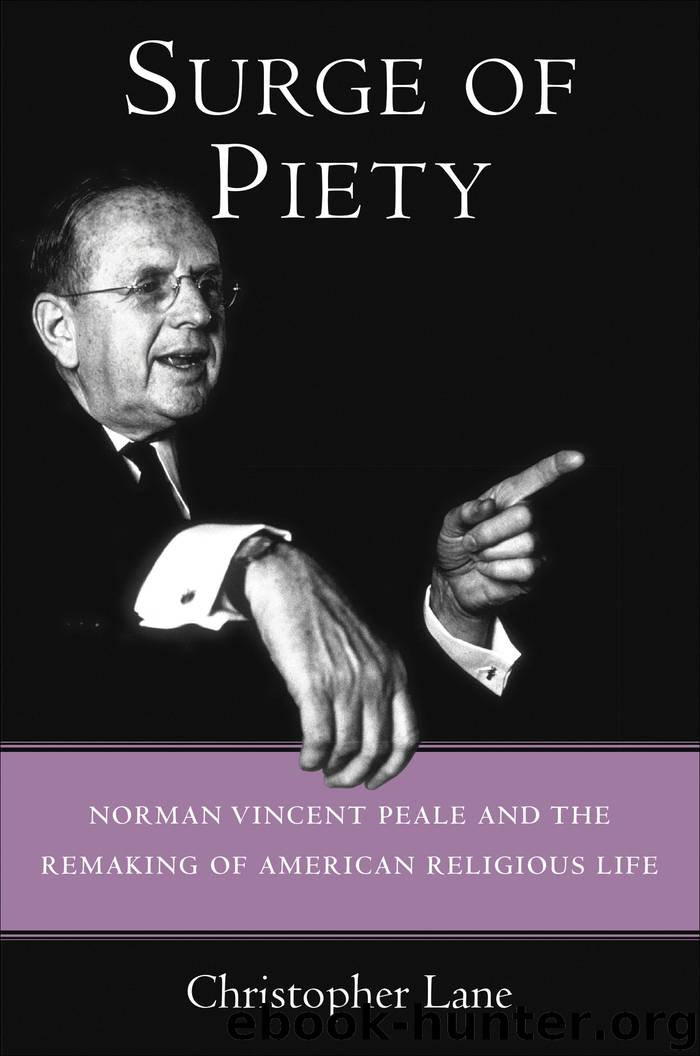
Author:Christopher Lane
Language: eng
Format: epub
Publisher: Yale University Press
Published: 2016-04-10T04:00:00+00:00
VI
Religion and Mental Health Rebalanced
In the opening issue of the 1960s, Harper’s Magazine lost no time declaring “goodbye to the ’fifties—and good rid- dance.” The Princeton historian Eric F. Goldman, who wrote the keynote article, placed the blame squarely on the religious revival: “We live in a heavy, humorless, sanctimonious, stultifying atmosphere…. Over the whole of this land, a kind of creeping piety, a false piety and religiosity … has slithered its way to astounding popularity.”1
The magazine article was designed to startle and provoke; the frustration with Peale-like positive thinking was everywhere apparent. In a sign of the wide-eyed enthusiasm that Goldman hoped to end, he quoted the high-profile broadcaster Arthur Godfrey as urging: “Don’t tell me about science and its exact explanation of everything. Some things are bigger. God is the difference. He gets around.”2
“Don’t tell me about science.” With Peale, not to mention other evangelicals, arguing that “religion may be said to form an exact science” and that religion and psychiatry could coexist quite happily, his many followers and admirers might think that problems identified by science were somehow already answered and explained.3
Like other critics of the revival, including those concerned about the notion and effects of “government under God,” Goldman wanted the whole edifice of “false piety and religiosity” dismantled, as if its now-widespread effects could best be countered by satire and mockery. “The ground must be cleared of confusing and distracting carry-overs from the past,” he wrote, “even from the immediate past.” Customs, traditions, and beliefs—if in any way backward-looking or irrational—needed to be swept away so that an “overfed, oversanctified” nation could focus on the challenges of a scientific age.4
On the relations between science and religion, other commentators were less extreme, recognizing that Americans’ religious beliefs were disparate, resilient, and likely only to harden in response to scorn. “Fully two-thirds of the adults in our country regard themselves as religious people,” the Harvard psychologist Gordon W. Allport reported midcentury, “and at least nine-tenths, by their own [account], believe in God.”5 At the time, ninety-three million Americans identified themselves as members of religious organizations.6 Even (or especially) with the revival fading among so-called mainline Protestants, Catholics, and Jews, evangelical conservatives continued to find considerable political support in the administration of Richard M. Nixon—and, in the coming decades, in those of Ronald Reagan and George W. Bush. Thus, an open call for satire and mockery seemed unlikely to narrow the still-yawning chasm between the country’s scientific followers and its religious communities.7
To many of the latter group, “Science Isn’t God,” the headline of a Southern newspaper in the early 1960s, rang true. It invoked fallibility and metaphysical authority, to say nothing of the stresses of the space age.8 That science—in particular, psychiatry—had its own controversies and blind spots, even as it sought to investigate them, drove such questions in the editorial as “Is it possible, as has been proposed, that a new science could be created to keep society from committing suicide with nuclear weapons? Can a science
Download
This site does not store any files on its server. We only index and link to content provided by other sites. Please contact the content providers to delete copyright contents if any and email us, we'll remove relevant links or contents immediately.
The Gnostic Gospels by Pagels Elaine(2531)
Jesus by Paul Johnson(2362)
Devil, The by Almond Philip C(2332)
The Nativity by Geza Vermes(2230)
The Psychedelic Gospels: The Secret History of Hallucinogens in Christianity by Jerry B. Brown(2157)
Forensics by Val McDermid(2094)
Going Clear: Scientology, Hollywood, and the Prison of Belief by Lawrence Wright(1985)
Going Clear by Lawrence Wright(1968)
Barking to the Choir by Gregory Boyle(1822)
Old Testament History by John H. Sailhamer(1815)
Augustine: Conversions to Confessions by Robin Lane Fox(1773)
The Early Centuries - Byzantium 01 by John Julius Norwich(1745)
A History of the Franks by Gregory of Tours(1729)
A Prophet with Honor by William C. Martin(1725)
Dark Mysteries of the Vatican by H. Paul Jeffers(1723)
The Bible Doesn't Say That by Dr. Joel M. Hoffman(1681)
by Christianity & Islam(1634)
The First Crusade by Thomas Asbridge(1610)
The Amish by Steven M. Nolt(1574)
